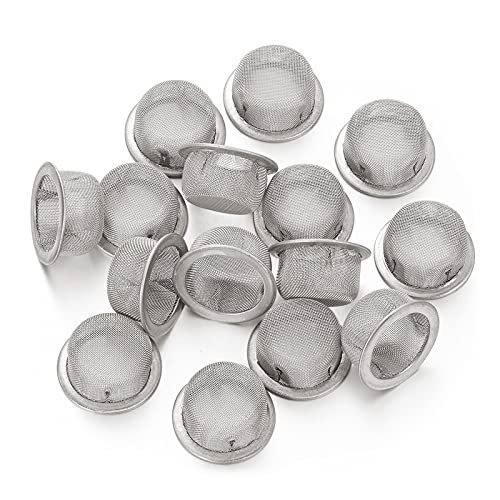
Material Composition: Stainless Steel vs. Titanium
The first decision you must make is the metal composition. Most standard screens are made from stainless steel. Stainless steel is the industry standard for a reason: it is highly resistant to corrosion, easy to clean, and holds its shape well under moderate heat. However, for those using high-temperature techniques or specialized torches, titanium screens are a premium alternative. Titanium offers a higher melting point and a slightly more neutral flavor profile. While stainless steel is more budget-friendly and widely available, titanium is the go-to for users who want a screen that can withstand extreme thermal stress without warping or degrading over time.
Micron Size and Mesh Density
The 'mesh' of a screen refers to how tightly the wires are woven together. This is measured in microns, which dictates how much material can pass through the holes. When selecting a screen for a larger, high-flow pipe, you face a trade-off between filtration and airflow. A very fine mesh (high density) will catch even the smallest particles of ash, providing a very clean hit, but it can also lead to 'clogging' where the airflow becomes restricted as the screen fills with residue. A coarser mesh (lower density) allows for much faster, more effortless draws, which is often preferred in larger pipes, but it may allow more fine debris through. For a stanker-style pipe, we generally recommend a medium-density mesh—something that balances the ability to draw deeply without sacrificing the cleanliness of the smoke.
How the screen sits in your bowl matters as much as what it is made of. Flat screens are the most versatile and can be trimmed to fit almost any diameter, making them ideal if you are experimenting with different glass pieces. However, they can sometimes shift during use. Curved screens are pre-shaped to fit specific bowl geometries, providing a more stable base that won't slide around. Then there is the 'egg crate' or 'dimpled' style. These screens feature small indentations that help trap ash in specific pockets, preventing it from settling flat against the mesh and blocking airflow. If your pipe has a deep, conical bowl, a shaped or dimpled screen will significantly extend the life of your session by maintaining consistent airflow.
Durability and Ease of Maintenance
Because these pipes are used for heavy sessions, your screens will accumulate resin and ash much faster than a standard small piece. Look for screens that are easy to clean. Stainless steel screens can often be revived with a quick soak in isopropyl alcohol, but if they become too heavily impregnated with resin, they can become a fire hazard or simply taste unpleasant. When shopping, consider whether you prefer buying high-quality, long-lasting individual screens or bulk packs of disposables. For heavy users, we recommend a hybrid approach: invest in a few high-grade titanium or thick-gauge steel screens for daily use, and keep a pack of budget-friendly replacements on hand for when the mesh finally becomes too clogged to salvage.