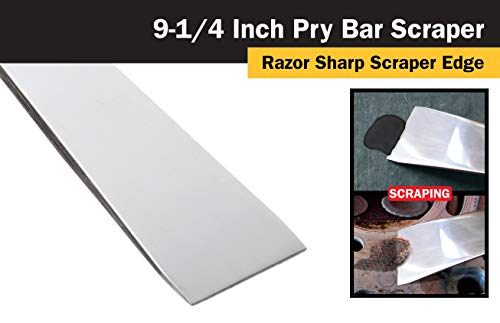
Understanding Material Composition and Hardness
The primary function of a pry bar is to withstand immense torsional stress without snapping or bending permanently. When evaluating Titan Tools, pay close attention to the metallurgy. High-quality pry bars are typically forged from heat-treated steel. Heat treatment is critical because it creates a balance between hardness (to prevent the tip from blunting during prying) and toughness (to prevent the bar from shattering under sudden impact). If you are working in environments where you will be striking the end of the bar with a hammer, look for models specifically engineered for high impact resistance to avoid catastrophic failure.
Profile and Tip Geometry
The shape of the tool's business end dictates its application. Titan Tools offers various geometries, and matching the tip to your task is the most important decision factor. For demolition work involving heavy timber or masonry, a wide, flat blade is essential to distribute force and prevent the tool from sinking too deeply into the material. Conversely, if you are performing delicate trim work or separating tight joints in cabinetry, you will require a slender, tapered tip that can slip into narrow gaps. Consider whether you need a 'claws' style for pulling nails or a flat-head style for spreading surfaces. Mixing these up can result in damaged workpieces.
Length and Leverage Ratios
Leverage is a mathematical certainty: the longer the handle, the less force you must apply to achieve the same prying power. However, length is a trade-off with maneuverability. A long pry bar is ideal for heavy-duty lifting and prying large structural elements where you have ample swing room. However, in cramped quarters like between wall studs or inside a vehicle, a long bar becomes a liability. When selecting your tool, categorize your tasks into 'heavy structural' and 'precision detail.' For structural work, prioritize length to maximize your mechanical advantage. For detail work, prioritize a shorter, more controlled profile.
Handle Ergonomics and Grip Stability
Prying is an intensive physical activity that often involves sweaty or dirty hands. A bar with a smooth, bare steel handle may provide strength, but it lacks the control needed for precision. Look for Titan Tools models that feature ergonomic grips or textured surfaces. These coatings serve two purposes: they provide a non-slip surface to prevent the tool from twisting in your hand under load, and they offer vibration dampening, which reduces hand fatigue during extended periods of use. A well-designed grip ensures that the energy you exert is transferred directly into the pry rather than being lost to hand slippage.
To make your final selection, follow this logic: If the task involves pulling fasteners from wood, prioritize a bar with a specialized claw. If the task involves separating large sheets of material, prioritize a wide-blade, long-handled bar. If the task involves fine woodworking, prioritize a slim-profile, short-handled bar. By categorizing your needs into these three pillars—geometry, length, and grip—you can ensure that your Titan Tools investment provides the reliability and power necessary for professional-grade results.