PickSmartly Buying Guide

Best 7 Variable Gain Amplifiers in 2026

9.2 PM Score
Products Compared
1
Brands Ranked
1
Our guides are compiled from product information and customer ratings. If you click on links we provide, we may receive compensation.

In the world of precision signal processing and RF engineering, a 7-variable gain amplifier is a highly specialized tool designed for granular control over signal amplitude. Unlike standard fixed-gain stages or simple two-step attenuators, these devices allow engineers to fine-tune signal strength across multiple discrete or continuous stages. Whether you are working in telecommunications, radar testing, or medical imaging instrumentation, selecting the right amplifier requires an understanding of how gain adjustments interact with noise floors, bandwidth, and linearity. This guide is designed to help you navigate the technical nuances of variable gain stages to ensure your signal chain remains stable and efficient.

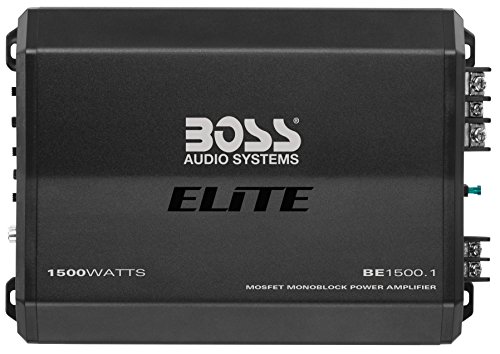
BOSS Audio Systems Elite BE1500.1 Monoblock Car Amplifier - 1500 Watts, 2 4 Ohm Stable, Class AB, Mosfet Power Supply, Great For Subwoofers

BOSS Audio Systems Elite BE1500.1 Monoblock Car Amplifier

BOSS AUDIO SYSTEMS BE1500.1 10.00 X 7.00 X 2.50 Inches
  • POWER: 1500 Watts Max x 1 @2-Ohms, 750 Watts Max x 1 @4-Ohms
  • CLASS A/B TOPOLOGY: Class ‘A’ amplifiers have enormous amount of current flowing through its output transistors with no audio signal. Class ‘B’ amplifiers have no current flowing through its outputs with no audio signal
  • MOSFET POWER SUPPLY: A MOSFET is an electrical switch that allows the flow of electrical current. It controls the output voltage and current precisely by removing the output current sensing loss And eliminating all secondary feedback circuitry
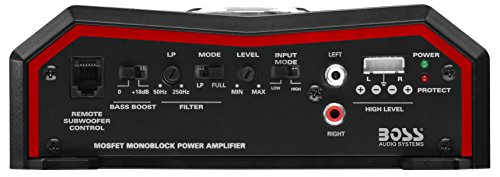
  • VARIABLE LOW-PASS CROSSOVER: Subwoofers reproduce sound based on a number of different low-range frequencies. You can set exact sound specifications for the bass frequency reproduction
  • SWITCHABLE BASS BOOST: Bass Boost allows you to adjust the low bass within the boost range to just the way you like it
  • VARIABLE GAIN CONTROL: The gain control is not for adjusting volume. It simply adjusts the amount of signal that is coming from your receiver and going to your amplifier
  • DIMENSIONS: The BE1500. 1 is 10 inches in Depth, 7 inches in Width and 2. 3 inches in Height. It weighs 4. 5 lbs.
  • : BOSS Audio Systems provides a Powerful 6 Year Platinum Online Dealer so long as the purchase is made through . We strongly encourage professional installation of this product to ensure proper and safe functionality
SELLER SELLER SCORE AMAZON FULFILLED PRIME FREE SHIPPING
loveyourstereo (Authorized Dealer)✔ 6.45 No No No

Most people assume high-wattage bass requires a massive, heavy footprint, but the BE1500.1 challenges that logic with a surprisingly compact build. This monoblock amplifier utilizes Class A/B topology to manage current flow efficiently, delivering up to 1500 Watts of max power at 2 Ohms. What actually makes it a standout for subwoofer enthusiasts is the precision control. The variable low-pass crossover and switchable bass boost let you dial in specific frequency responses rather than settling for generic thumps. The integrated MOSFET power supply ensures the voltage remains stable by eliminating secondary feedback circuitry. While you'll want to get this professionally installed to maximize safety, the combination of a 750 Watt output at 4 Ohms and a lightweight 4.5 lb frame makes it a highly versatile choice for upgrading your vehicle's low-end response.

What We Like
1500 Watts max power
Class A/B topology
Variable low-pass crossover
Switchable bass boost
MOSFET power supply
Buying Guide

A Guide to Selecting the Best 7 Variable Gain Amplifiers

A Guide to Selecting the Best 7 Variable Gain Amplifiers

Understanding Gain Range and Step Resolution

The most critical factor when evaluating a 7-variable gain amplifier is the total dynamic range and the resolution of the gain steps. In many applications, you aren't just looking for 'more' or 'less' gain. You are looking for a specific, repeatable value to maintain signal integrity. Determine if your application requires discrete steps (where the amplifier jumps between seven specific, predefined gain levels) or continuous adjustment. If you are working with automated test equipment (ATE), look for amplifiers that offer high-resolution digital control via interfaces like SPI or I2C. This allows your control software to command exact gain settings without manual intervention, which is vital for repeatable laboratory results.

Noise Figure and Signal-to-Noise Ratio (SNR)

Every time you introduce an amplification stage, you introduce noise. In high-sensitivity applications, such as satellite communications or deep-space telemetry, the Noise Figure (NF) is the make-or-break specification. A variable gain amplifier that provides high gain but significantly degrades the SNR can render the subsequent stages of your system useless. When comparing models, look at the noise figure across the entire gain range. Often, as you decrease the gain (attenuating the signal), the effective noise figure can rise. You want an amplifier that maintains a low, consistent noise floor regardless of which of the seven gain settings is active.

Bandwidth and Frequency Response

A variable gain amplifier is only as good as the frequency range it can handle. You must match the amplifier’s bandwidth to your operating frequency. However, there is a hidden complexity: gain flatness. In many variable gain architectures, the gain might be stable at 1 GHz but fluctuate wildly at 5 GHz. For wideband applications, look for amplifiers that promise 'flatness' across the specified bandwidth. This ensures that your signal isn't unintentionally filtered or distorted by the amplifier itself as you sweep through different frequencies.

Linearity and Third-Order Intercept Point (IP3)

If your signal chain involves complex modulation schemes (like QAM), linearity is paramount. High-power signals can drive an amplifier into non-linear regions, creating unwanted harmonics and intermodulation distortion. Check the Input Third-Order Intercept Point (IIP3) and Output Third-Order Intercept Point (OIP3) specifications. A higher IP3 indicates that the amplifier can handle stronger signals without creating significant distortion. If your application involves high-frequency carriers or high-order modulation, prioritize an amplifier with a robust IP3, even if it means sacrificing a bit of total gain.

Impedance Matching and Integration

Finally, consider how the amplifier will integrate into your existing hardware. Most RF systems operate on standard impedance profiles, typically 50 ohms. Ensure the amplifier provides excellent Return Loss and VSWR (Voltage Standing Wave Ratio) to prevent signal reflections that can cause instability or standing waves in your system. Additionally, consider the physical form factor—whether you need a surface-mount component for a custom PCB or a modular unit for a test bench setup.

Ready to choose?

Jump back to our ranked picks or compare the shortlist side by side.

Frequently Asked Questions

Quick answers about 7 Variable Gain Amplifiers before you buy.

Fixed gain amplifiers provide a constant, predetermined level of signal amplification, whereas variable gain amplifiers allow you to manually or electronically adjust the amplification factor to suit changing signal strengths.

It controls the amount of amplification applied to the input signal. By adjusting the gain, you can increase the signal's amplitude for weak inputs or decrease it to prevent clipping and distortion when the input is too strong.

Consider the dynamic range of your input signal. You need an amplifier that can boost your weakest expected signal to a usable level while also providing enough attenuation to handle your strongest peaks without saturating the output.

A higher SNR is critical because as you increase the gain, you also amplify the internal noise of the amplifier. High-quality variable gain amplifiers are designed to increase signal strength while keeping the noise floor as low as possible.

Yes. Many modern variable gain amplifiers feature Automatic Gain Control (AGC), which automatically adjusts the gain level to maintain a consistent output amplitude despite fluctuations in the input signal.

The gain bandwidth product is a measure of how much gain an amplifier can provide relative to the frequency of the signal. As you increase the gain, the usable frequency range typically decreases. Choosing an amplifier with a high product ensures performance across a wider spectrum.

If the gain is set too high for the amplifier's voltage rails or the input signal's intensity, the signal will 'clip,' resulting in harmonic distortion. It is essential to find the optimal balance between amplification and signal integrity.
Rankings & Insights

Our 7 Variable Gain Amplifiers Rankings

1 Products Compared
9.2 Avg PM Score
1 Brands Ranked

Top 10 7 Variable Gain Amplifiers Brands on Amazon

Share of top-ranked products by brand, from our rankings.

  1. 01 Boss Audio Systems 1 (100%)

How We Selected These Products

We compared 7 Variable Gain Amplifiers products using product details and customer ratings to identify the best options in the categories..

From that comparison we shortlisted the top 1 7 Variable Gain Amplifiers for this page..

We aim to help you find the right amplifiers products for your needs and save you time when choosing which 7 Variable Gain Amplifiers to buy.

Side by Side

Comparison Table

Compare the top 1 picks at a glance — select a column to sort.