

QUDODO Guitar Chord Learning Tools, Practice Acoustic Guitar Accessories, Guitar Trainer No Need to Develop Callouse, Eliminates Finger Pain and Strin...
Qudodo Guitar Chord Learning and Practice Tool
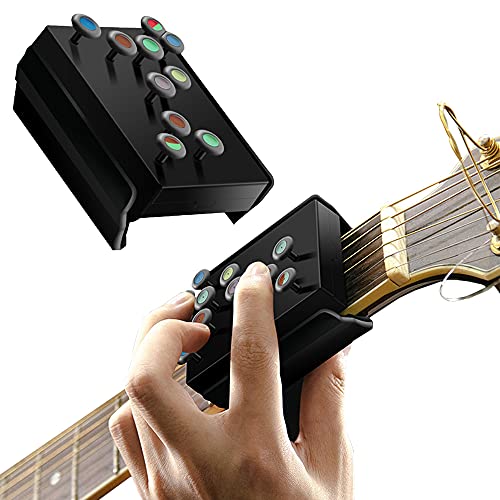
- ★☆Universal Chord: Each color of the chord guitar aid represents a chord. By pressing the button with the corresponding color to play a specific chord, it is easy to remember and the fingers do not hurt. It has more than 20 different suppression methods, covering almost 99% of the songs.
- ★☆Training function: The chord learning tool can help you do hand postures and practice hand muscle memory. Improve the efficiency of chord conversion and make playing more smoothly. Train your fingertips to exert strength vertically and cultivate the correct hand shape.
- ★☆Easy to install: The chord learning tool can be installed just by clamping it on the neck of the guitar. The installation is simple and there is no complicated process.
- ★☆Scope of application: Specially designed for 36-41 inch folk guitar, chord less than 4.5cm, fretboard size is about 4.3-4.5cm.
- ★☆Applicable to the crowd: One-click easier to understand and remember guitar chords. Easily solve problems such as inability to remember chords, slow chord transitions, and inability to persist with hand pain. Suitable for guitar beginners and all people.
| SELLER | SELLER SCORE | AMAZON FULFILLED | PRIME | FREE SHIPPING |
|---|---|---|---|---|
| QDCECO-online | 5.05 | Yes | Yes | Yes |
Learning guitar usually requires a brutal rite of passage involving bleeding fingertips and thick callouses, but the Qudodo chord trainer completely bypasses that painful phase. Instead of wrestling with steel strings, you use color-coded buttons to master over 20 different suppression methods that cover nearly every song you'll ever want to play. It clamps directly onto the neck of 36-41 inch folk guitars, making it incredibly easy to set up without any tools. By focusing on vertical finger strength and muscle memory through these simulated chord shapes, you can bridge the gap between knowing a chord and actually playing it smoothly. It is a clever way to build the correct hand posture and transition speed before the physical discomfort of real strings sets in.


